On the afternoon of October 23, 2026, the academic lecture "Silk Road Scholarship, Translation Bridges Hearts" — part of the distinguished lecture series of the China–Uzbekistan Center for Mutual Learning of Civilizations — opened at the University Academic Lecture Hall. Hosted by the School of International Education and co-organized by the School of Foreign Languages, the event stood at the forefront of China–Uzbekistan cultural and people-to-people exchange, focusing on the development of international Chinese-language education and the practice of rendering Central Asian literature into Chinese. It served as a high-level platform for dialogue between scholars of the two countries and for academic discussion among teachers and students.
Professor Jasur Ziyamukhamedov, Professor at the Higher School of Sinology, Tashkent State University of Oriental Studies (Uzbekistan), Visiting Professor at Liaoning Normal University, and Uzbek Co-Director of the China–Uzbekistan Center for Mutual Learning of Civilizations, was invited to deliver a keynote report entitled "Difficulties and Solutions in the Chinese Translation of Abdulla Qahhor's Short Stories." The lecture was chaired by Professor Cao Ru, Dean of the School of International Education, with Professor Li Baogui serving as academic discussant. Teachers and students from the School of International Education and the School of Foreign Languages, as well as international students in the China–Uzbekistan "2+2" joint training program, were present.
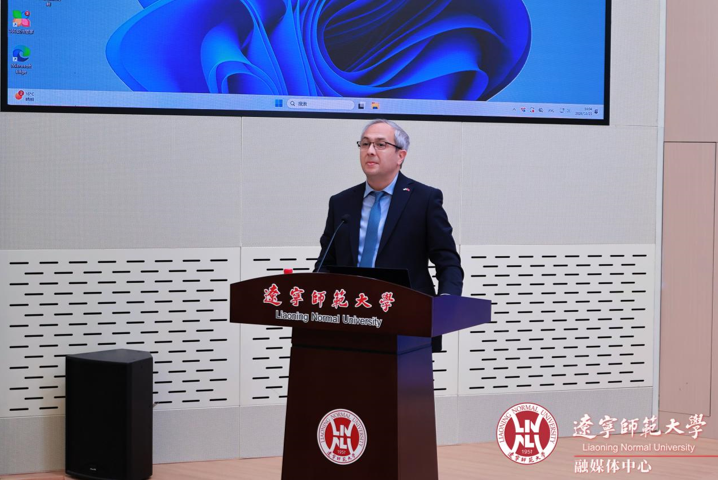
The report comprised two major parts: the current state of Chinese-language teaching in Uzbekistan, and the practice of literary translation. Professor Ziyamuhammedov outlined the development of Chinese-language education in Uzbekistan, noting that more than ten Uzbek universities have established joint training programs with Chinese counterparts. Among these, the Chinese-language "2+2" program jointly developed by Tashkent State University of Oriental Studies and Liaoning Normal University stands as a key outcome of cooperation. Tens of thousands of Uzbek young people are currently pursuing studies at universities across China. As of April 2026, the number of Chinese-funded enterprises in Uzbekistan had reached 5,398, with pronounced demand for Chinese-language talent in sectors such as energy and automobile manufacturing — underscoring the broad prospects for Chinese-language education. He also reviewed the Confucius Institutes in Uzbekistan: the Confucius Institute at Tashkent State University of Oriental Studies was the first of its kind in the world; the Samarkand Confucius Institute has already been established; and Liaoning Normal University is partnering with Urgench State University to bring the third Confucius Institute to the city of Khiva.
Drawing on his own research on Pu Songling, Professor Ziyamukhamedov shared his hands-on experience in the Uzbek–Chinese bilingual translation of the short stories of Abdulla Qahhor, a leading realist writer of Uzbekistan. Qahhor's works are deeply rooted in everyday urban life, and the texts abound in folk costume terms, religious proper nouns, folk proverbs, and archaic vocabulary, posing considerable translation challenges. For different categories of culture-loaded words, he proposed a classified translation strategy: transliteration of ethnic costume terms to preserve their original character; transliteration of religious terminology supplemented by endnotes; rendering proverbs so as to match the resonance of Chinese expression; and flexible free translation of rare concepts that have no direct equivalent in the Chinese context — preserving the original style while adapting to the reading experience of the Chinese audience.
Following the report, Professor Li Baogui, as academic discussant, offered an in-depth commentary. He observed that the report combined a macro-level vision of regional cooperation with the grounded depth of translation practice, and that the vivid, authentic translation cases were of exceptional inspirational value. Chinese-language education is an important bond connecting the hearts and minds of the two peoples, and literary translation and introduction is an indispensable vehicle for mutual learning between civilizations. This bilingual edition, he noted, carries multiple values: for general readership, classroom teaching, and cultural diplomacy. He further suggested that future research could be deepened along three lines: first, examining the reception and dissemination of the translated work within the Chinese context; second, introducing translation-studies perspectives to conduct comparative research on the Chinese translation of Central Asian literature; and third, promoting the adaptation of the translated work into teaching resources for international Chinese-language education.
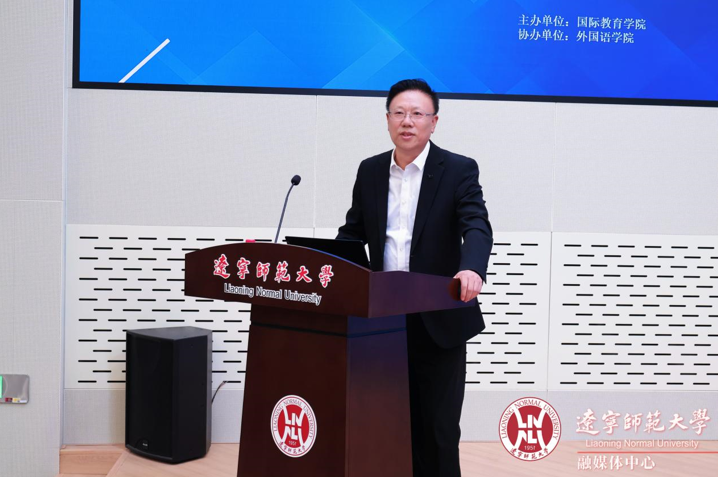
Thereafter, both sides engaged in a lively discussion on topics including the training of local Chinese-language teachers, the classroom application of bilingual translations, and the dissemination of Central Asian literature in the new-media era. Professor Li Baogui remarked that the proactive translation of national literature into Chinese by Central Asian scholars is itself a vivid embodiment of mutual learning between civilizations. Going forward, he said, we should take language and script as the foundation, cultural exchange as the core, and mutual learning and cooperation as the bridge, continuously consolidating the cultural and people-to-people foundation of the China–Uzbekistan community with a shared future, and ensuring that the friendship between the two countries is carried forward from generation to generation. Professor Ziyamuhammedov responded to each question in turn and expressed his expectation of deepening cooperation with Liaoning Normal University in the fields of translation, literature, and cultural education.
During the interactive Q&A session, teachers and students in the audience raised questions with enthusiasm on topics such as the choice of translation strategies, the handling of folk-culture-specific terms, and comparative research on Chinese and Uzbek short fiction. Professor Ziyamuhammedov answered patiently and thoroughly, encouraging young students to strive to become youth ambassadors for China–Uzbekistan cultural exchange. The atmosphere was warm and the academic ambiance was rich.

This lecture is a flagship academic activity launched by the China–Uzbekistan Center for Mutual Learning of Civilizations following its official inauguration in June 2026. It also represents a significant practice of the University in deepening China–Uzbekistan cultural and educational exchange and advancing the disciplinary development of international Chinese-language education. Liaoning Normal University will continue to build high-level international academic exchange platforms, support the high-quality development of international Chinese-language education, and cultivate more young cultural ambassadors who connect China and Uzbekistan and bridge Chinese and foreign cultures.